
Educational article — general information only
ASX Trading Hours and the Global Session Clock
Published 12 July 2026 · Updated 26 July 2026

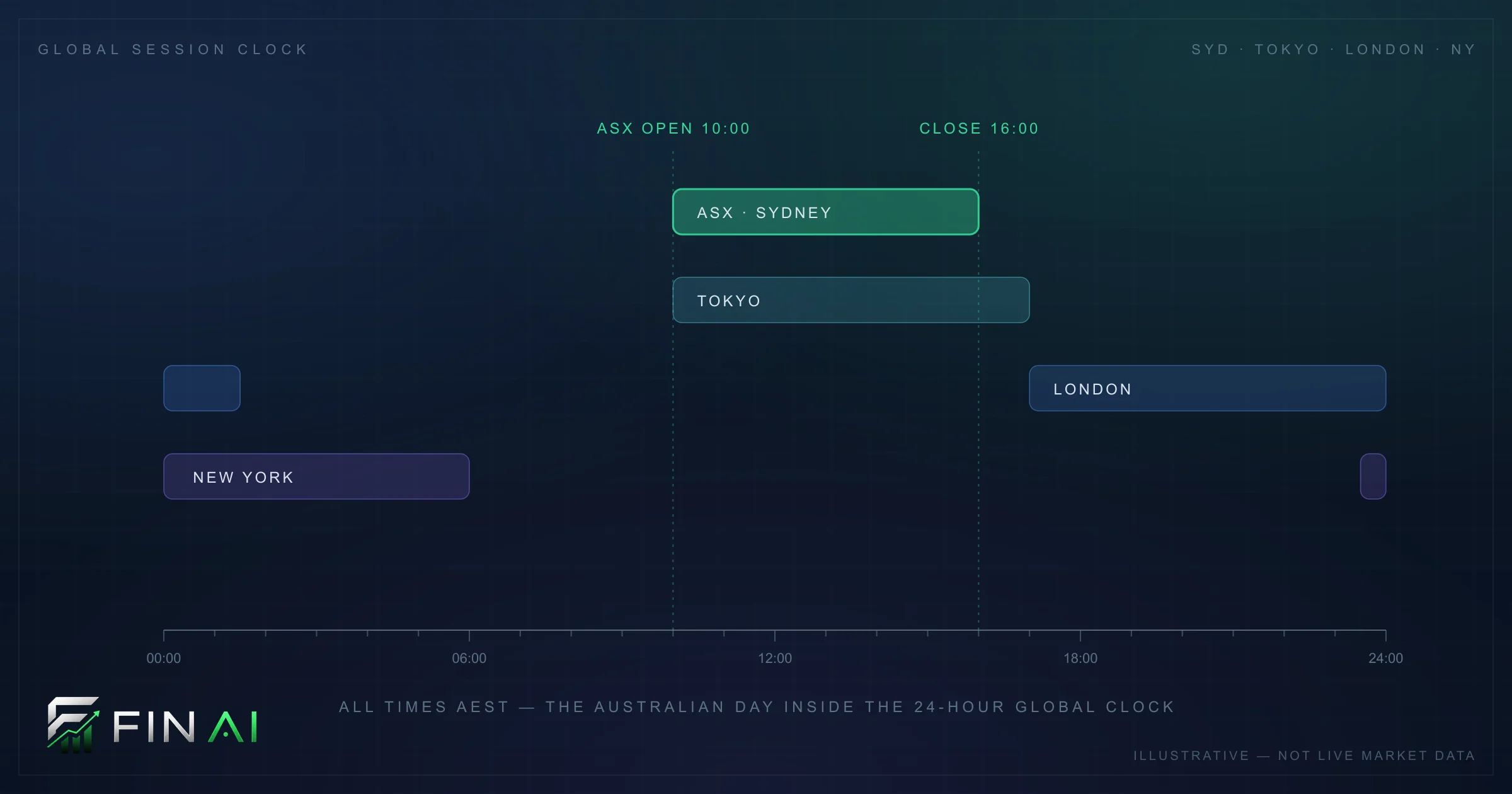
The ASX trades from 10:00am to 4:00pm Sydney time on business days, with a staggered opening auction from 10:00am and a closing auction shortly after 4:00pm. Those six hours, though, are only part of the story — the Australian market lives inside a 24-hour global clock.
Understanding that clock explains most 'mysterious' ASX moves: gaps at the open, drift after lunch, and sudden afternoon turns when Asian markets or US futures shift.
The mechanics of the ASX day
The open is not a single moment: stocks open in groups alphabetically between roughly 10:00 and 10:09am via an auction that matches accumulated overnight orders. This is why early prices can jump around — the auction is digesting a whole night of global information at once.
The closing auction after 4:00pm sets official closing prices and handles large end-of-day flows, particularly from index funds. Unusual volume at the close is often mechanical rather than informational.
What the ASX inherits each morning
By the Sydney open, the US session has fully closed. Wall Street's result — plus moves in commodities and the AUD overnight — arrives via SPI 200 futures, which trade almost around the clock and estimate where the ASX should open. A big futures gap means the day's first move happened while you slept.
This inheritance is why checking three things before the open — US close, commodities, AUD — frames most of the morning better than any local headline.
The afternoon: Asia wakes up
From late morning Sydney time, major Asian markets open — Tokyo, then Hong Kong and Shanghai. Chinese data releases and market moves can redirect the ASX afternoon, particularly for miners tied to Chinese demand.
US futures also trade through the ASX day, and a sharp move in them — often on European news as that region wakes — can turn the local market late in the session.
Using the clock in practice
The session clock suggests natural checkpoints: pre-open (what did we inherit?), late morning (is Asia confirming or fighting the open?), and the close (was the finish real buying or auction mechanics?). Investors who respect these rhythms stop treating every intraday wiggle as company news.
FinAI's market view is organised around exactly this rhythm — overnight influences, local sector posture and risk context in one place. General information, as always: sessions explain timing, not outcomes.
Frequently asked questions
- What time does the ASX open and close?
- Normal trading runs 10:00am to 4:00pm Sydney time on business days, with an opening auction staggering stock opens until about 10:09am and a closing auction shortly after 4:00pm.
- Why did a stock gap up at the open with no news?
- The opening auction digests all overnight information at once — US moves, commodities, currency. The gap is the market repricing to the world, not necessarily anything company-specific.
- Do US markets affect the ASX during the Australian day?
- Yes — US index futures trade around the clock, and sharp moves in them during Sydney hours frequently redirect the ASX afternoon.
- Does FinAI show pre-market information?
- FinAI organises overnight context — global session results and their likely local relevance — into its market view, as general information for your own preparation.
FinAI is an AI-assisted market intelligence platform for Australian investors. It does not provide personal financial advice or execute trades.
Request Australian access