
Educational article — general information only
Market Sentiment Explained: Reading the Mood Without Being Ruled by It
Published 21 July 2026 · Updated 26 July 2026

Market sentiment is the aggregate mood of investors — optimism or pessimism about where prices are heading. It shows up in surveys, positioning data, options markets, news tone and the way prices react to information. It is real, measurable and genuinely useful — and also one of the easiest signals to misuse.
The misuse comes from treating sentiment as a direction arrow. Strong sentiment does not mean prices rise next; famously, extremes of mood often precede reversals. Sentiment is context, not command.
Where sentiment data comes from
Traditional sentiment sources include investor surveys, fund positioning, put/call ratios and volatility indices. Each captures a different crowd: surveys capture what people say, positioning captures what they have done, options markets capture what they are paying to protect against.
AI systems add a newer layer: natural-language processing across news, announcements and commentary at scale, scoring tone and topic faster than any human reader. The strength of the AI approach is breadth; its weakness is that text tone and market impact are not the same thing — which is why structured aggregation beats raw 'news mood'.
How to read sentiment usefully
Sentiment earns its place as a moderating input. When your analysis is bullish and sentiment is already euphoric, the trade is more crowded than it looks — expectations are high, and disappointment moves prices further than confirmation. When analysis is bullish and sentiment is fearful, the same idea has more room to be right.
The practical habit: note sentiment when it is extreme, in either direction, and let it adjust your sizing and expectations rather than your direction. Mid-range sentiment readings rarely deserve any weight at all.
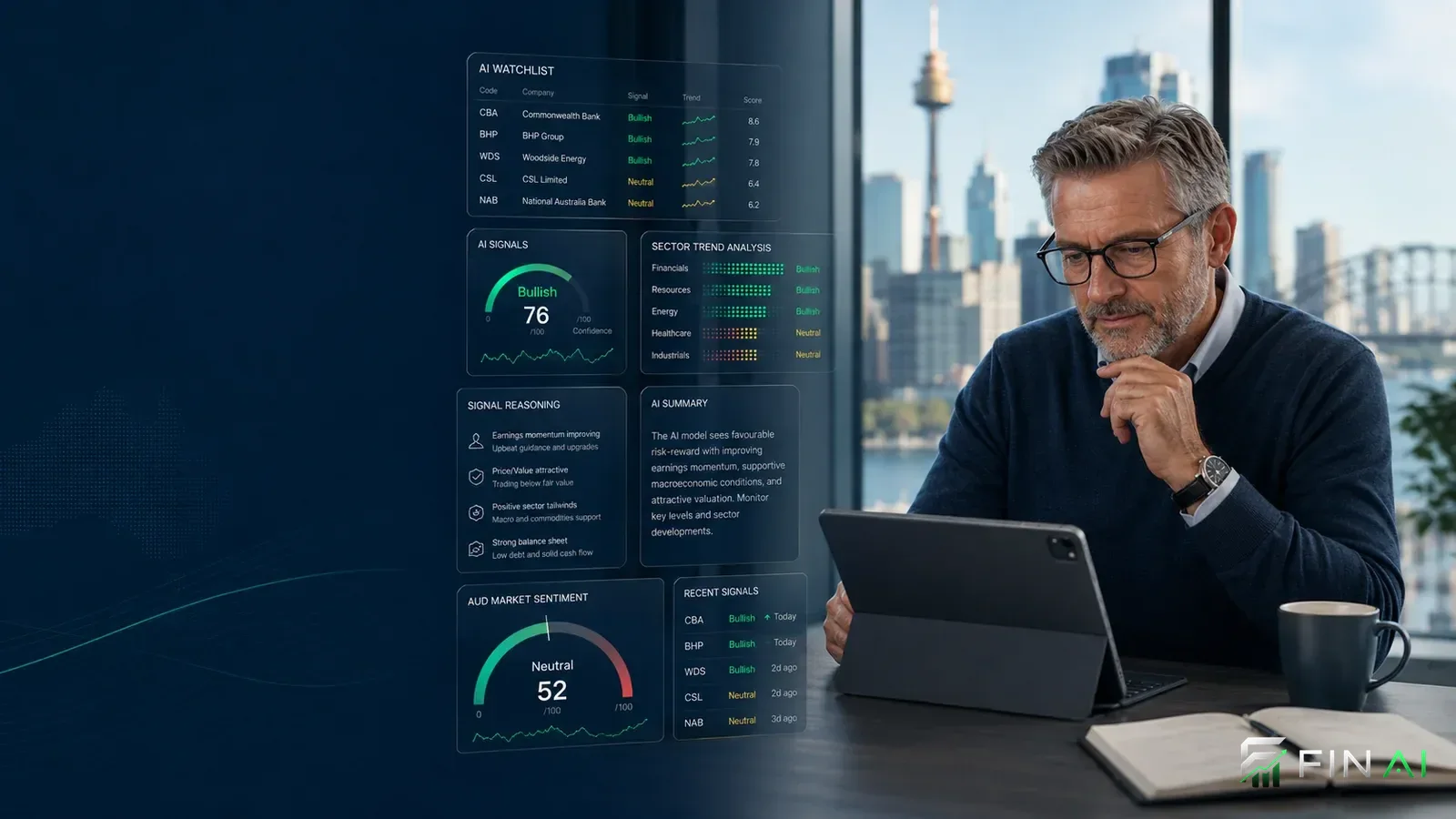
Sentiment on the ASX specifically
Australian sentiment inherits heavily from the US session: a fearful close on Wall Street usually opens Sydney fearful, whatever the local news. Domestic layers then adjust the picture — commodity moves, bank results, RBA language — sometimes reinforcing the imported mood and sometimes fighting it.
Watching which layer is winning — imported versus domestic — often explains ASX days that otherwise look irrational.
How FinAI presents sentiment
FinAI aggregates sentiment across sources into a structured reading, shown beside — never instead of — trend and volatility. The design intent is exactly the framework above: sentiment as context that colours your interpretation of everything else, not a thermometer to trade off.
As with every FinAI view, sentiment is general information. Extremes can persist longer than anyone expects, and no sentiment reading guarantees any outcome.
Frequently asked questions
- Is high bullish sentiment a buy signal?
- Often the opposite deserves consideration: when optimism is extreme, expectations are already priced in and disappointment carries more force. Sentiment is best used to adjust sizing and expectations, not direction.
- How does AI measure sentiment from news?
- Natural-language models score the tone and topics of news, announcements and commentary at scale, then aggregate the scores. This gives breadth no human reader can match, though tone and actual market impact are not identical.
- Why does ASX sentiment follow the US so closely?
- The US session closes just before Sydney opens, so its mood is imported into the ASX open through futures and the currency before local factors have a say.
- Where does sentiment appear in FinAI?
- As a structured reading on the dashboard beside trend and volatility, so it can moderate your interpretation of signals rather than being read in isolation.
FinAI is an AI-assisted market intelligence platform for Australian investors. It does not provide personal financial advice or execute trades.
Request Australian access