
Educational article — general information only
What Is AI Stock Analysis? A Plain-English Guide for Australian Investors
Published 15 July 2026 · Updated 26 July 2026

AI stock analysis is the use of machine-learning models to organise market data — prices, volumes, breadth, sentiment, volatility — into structured, readable descriptions of what is happening. Done honestly, it is a research aid: a way to cover more ground, more consistently, than any human can alone.
The term is also widely abused. Some products use 'AI' to dress up simple indicators; others imply prediction where none is possible. This guide explains what the technology genuinely does, so you can evaluate any AI investing tool — including FinAI — with clear eyes.
What AI stock analysis actually does
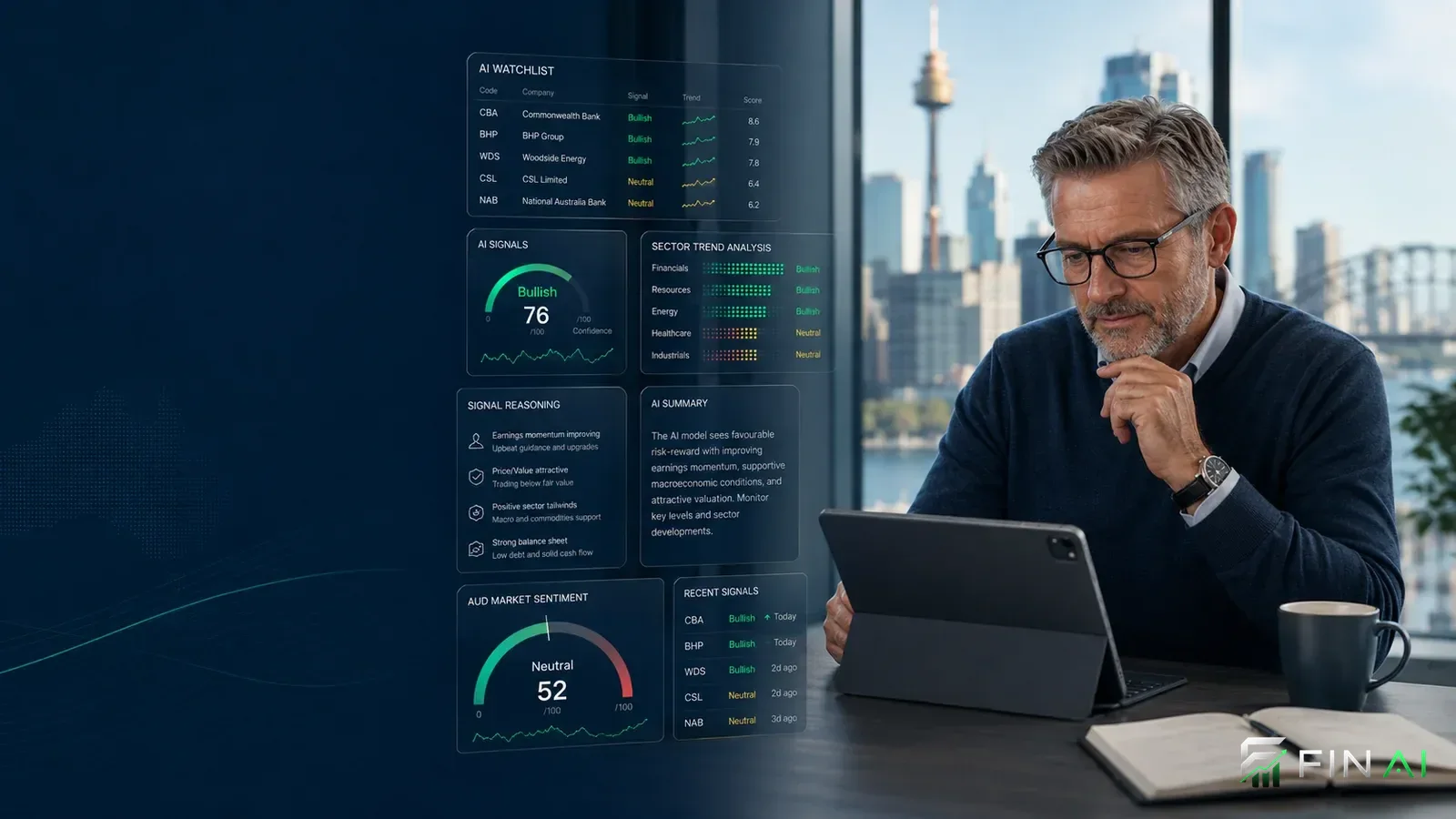
Under the hood, AI stock analysis applies statistical models to large volumes of market data. Typical outputs include trend classification (is this instrument in an uptrend across timeframes?), momentum and breadth measures, volatility context (is movement unusually wide?), and sentiment aggregation from news and other text sources.
The genuine advance over traditional charting is scale and consistency: the same disciplined lens applied to hundreds of instruments every day, without fatigue, recency bias or emotional attachment to yesterday's view. The output is a description of current conditions — a compressed, readable summary of data no human could review manually.
What it cannot do — and why honest tools say so
No AI model knows next week's news. Earnings surprises, central-bank decisions, geopolitical shocks — the events that move markets most — arrive from outside the price data. A model can describe the present; it cannot see around corners, and any product claiming otherwise deserves deep scepticism.
AI also cannot know your circumstances: your horizon, tax position, existing exposures or tolerance for loss. That is why AI stock analysis is decision support, never a decision. Australian regulation draws the same line — general information is different from personal financial advice, and honest tools stay clearly on the general-information side.
How Australian investors typically use it
The most productive use is as an attention filter. Instead of scrolling every ticker, an AI engine highlights where data has changed — a trend turning, breadth narrowing, volatility jumping. You then apply judgement to the short list: does the change matter, is the story intact, does it fit the portfolio you want?
For ASX-focused investors, context matters as much as signals: how the overnight US session, the AUD and commodities frame the local day. AI systems built for the Australian market organise that context alongside signals rather than treating Sydney as an afterthought of New York.
Evaluating an AI investing tool: the questions that matter
Four questions separate serious tools from marketing: Does it explain its signals in plain English, or hide behind scores? Does it show risk and volatility beside every signal, or only the bullish story? Does it claim prediction or describe conditions? And does it execute trades automatically, or leave every decision with you?
FinAI's answers are: plain-English reasoning on every signal, risk shown as a first-class view, no prediction claims, and no trade execution ever. Whatever tool you evaluate, insist on the same transparency.
Frequently asked questions
- Is AI stock analysis the same as algorithmic trading?
- No. AI stock analysis organises information for a human decision-maker. Algorithmic trading executes trades automatically. A tool can do the first without ever doing the second — FinAI, for example, never executes trades.
- Can AI pick winning ASX stocks?
- No tool can reliably predict which stocks will rise. AI can describe current data — trend, momentum, volatility, sentiment — with breadth and consistency, which is useful context for your own research, not a substitute for it.
- Is AI stock analysis suitable for beginners?
- Plain-English tools can help newer investors see how professionals frame markets — trend, risk, context — but they do not remove risk. Anyone investing should understand that losses are possible and consider whether professional advice suits their circumstances.
- Does FinAI provide financial advice?
- No. FinAI provides general market information and AI-assisted decision support for Australian investors. It does not consider personal circumstances, does not provide personal financial advice and does not execute trades.
FinAI is an AI-assisted market intelligence platform for Australian investors. It does not provide personal financial advice or execute trades.
Request Australian access