
Educational article — general information only
What Moves AUD/USD: The Currency Behind the Australian Market
Published 16 July 2026 · Updated 26 July 2026

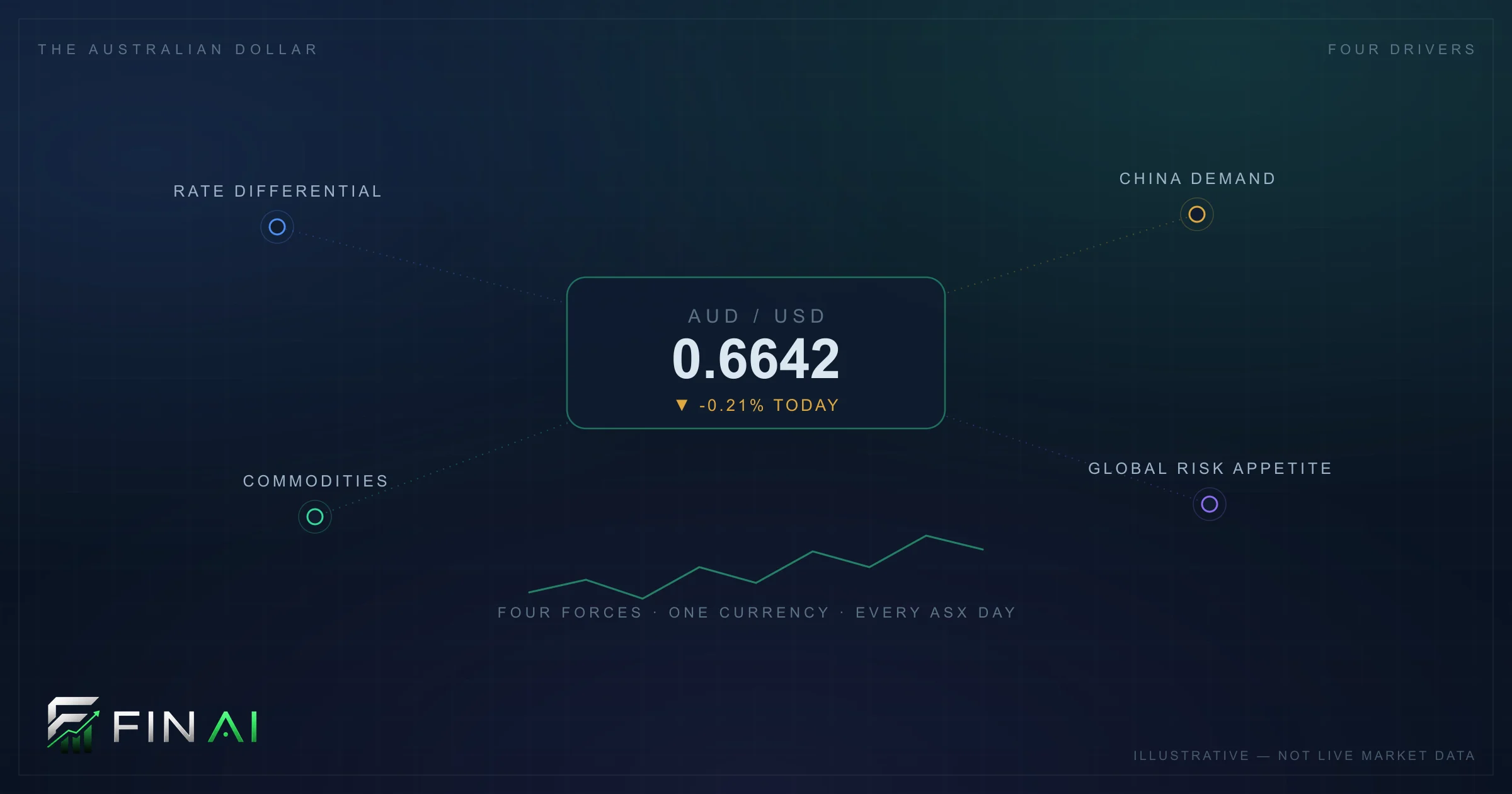
AUD/USD is the most-watched number in Australian finance after the ASX 200 itself — and the two are deeply entangled. The currency moves on four main forces: interest-rate differentials, commodity prices, Chinese demand and global risk appetite.
Equity investors sometimes treat the currency as someone else's problem. It is not: the AUD moves company earnings, sector performance and the offshore value of every Australian portfolio.
Force one: the rate differential
Money flows toward yield. When Australian interest rates sit above US rates, holding AUD pays; when the gap inverts, capital drifts the other way. What moves the currency day to day is not the current gap but expectations of its future — every RBA statement and US inflation print reprices that path.
This is why AUD/USD often jumps on US data at 10:30pm Sydney time: the American half of the differential just moved.
Forces two and three: commodities and China
Australia sells the world iron ore, coal, gas and gold, so the terms of trade flow straight into currency demand. Iron ore strength has historically been AUD strength; energy prices add their own channel.
China stands behind much of that demand, which makes the AUD a liquid, tradable proxy for Chinese growth sentiment. Stimulus announcements in Beijing can move the Australian dollar within minutes — often before Australian markets are even open.
Force four: global risk appetite
The AUD is a 'risk-on' currency: when investors feel confident they reach for growth-linked assets, and when they panic they retreat to the USD, yen and franc. In stressed markets the AUD often falls regardless of anything domestic — it is serving as the world's tradable expression of caution.
This gives Australian investors a useful tell: a falling AUD alongside falling equities signals imported, global risk-off; a falling AUD with stable equities suggests a more local repricing.
Why equity investors should care
Currency moves redistribute earnings across the ASX: a weaker AUD boosts offshore earners (healthcare, select tech, resources' USD revenue) and squeezes importers and domestic retailers with USD costs. Sector rotation often follows sustained currency trends.
FinAI presents AUD context beside sector and signal views for exactly this reason — the currency is market information, not a separate subject. General information, as always; currency markets can move sharply and unpredictably.
Frequently asked questions
- Why does the AUD fall when markets panic?
- The AUD is a growth-linked 'risk-on' currency. In stress, global capital retreats to the USD, yen and franc, selling risk currencies like the AUD almost mechanically — regardless of Australian news.
- Which ASX sectors benefit from a weaker AUD?
- Companies earning offshore revenue — much of healthcare, parts of technology, and resources with USD-priced sales — see earnings translated into more Australian dollars. Importers and USD-cost retailers feel the squeeze.
- How does China move the Australian dollar?
- Through commodity demand: Chinese construction and stimulus expectations drive iron ore and energy demand, and the AUD trades as the liquid proxy for that story.
- Where does FinAI show currency context?
- AUD context appears in the market view beside sectors and signals, so currency information frames equity reading rather than living in a separate tab.
FinAI is an AI-assisted market intelligence platform for Australian investors. It does not provide personal financial advice or execute trades.
Request Australian access